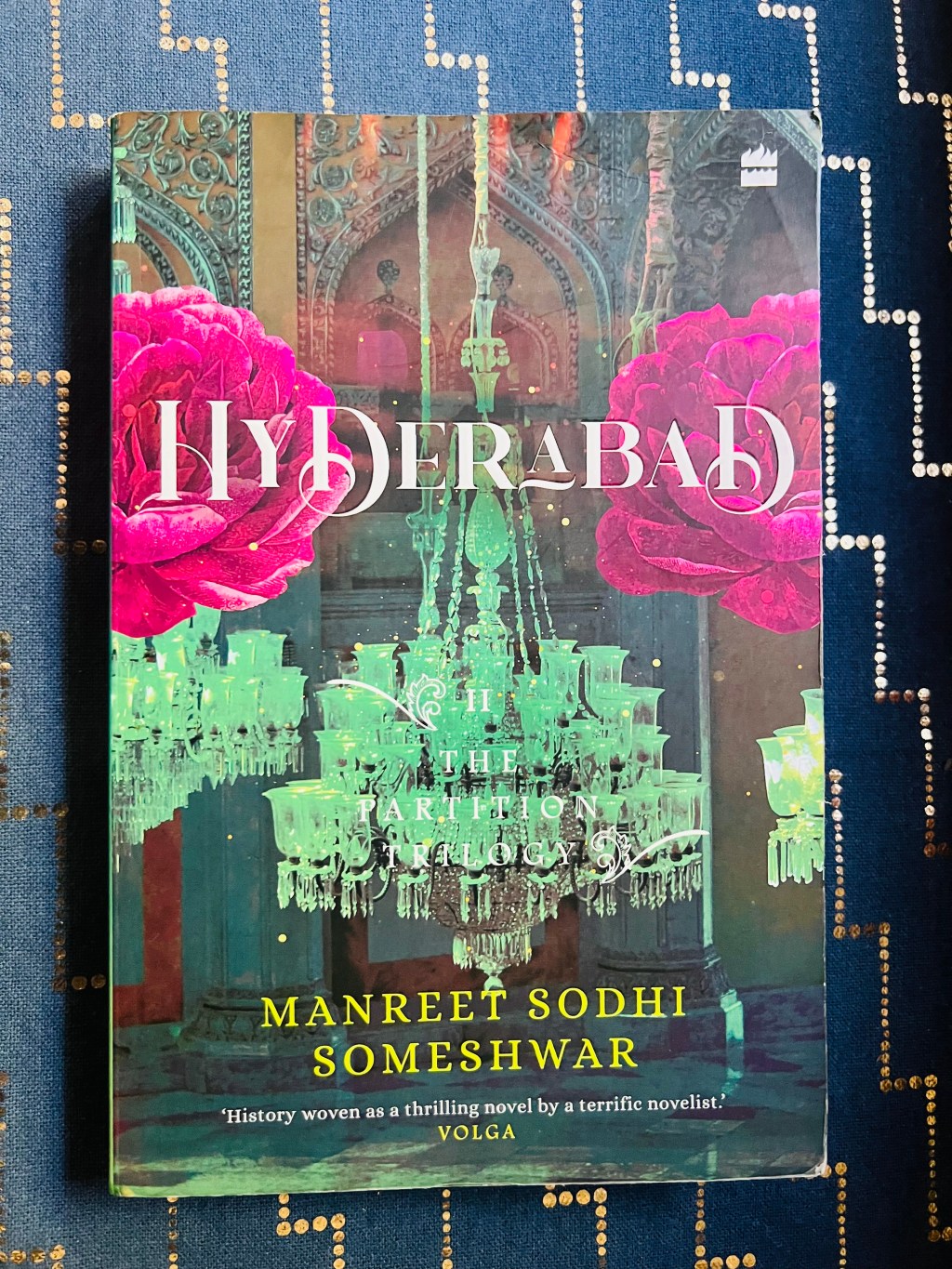
Author: Manreet Sodhi Someshwar
Publisher: Harper Collins India
Genre: Historical Fiction
First Publication: 2022
Language: English
“Hyderabad” is the story of its accession to India after independence and partition. A story of bloodshed, politics, rebellion and grave stubborn determination.
It is the not-so-famous tale surrounding the trauma of partition brought to light by Manreet Sodhi Someshwar.
“When it comes to partition, people generally talk about Punjab, Kashmir and Bengal. But the story of Hyderabad was kind of forgotten. When I started researching, I found that there is this entire story about Hyderabad. This is my story of Hyderabad and there might be millions of stories yet to be told about the partition”, says Manreet Sodhi. ( https://www.newindianexpress.com/states/telangana/2023/jan/30/hyderabad-partition-story-world-of-magnets–highlights-ofliterary-festival-final-day-2542547.html)
This book is the second in series of the partition trilogy penned by Manreet Singh Sodheshwar… the first being “Lahore” and “Kashmir” the next in line.
Mir Osman Ali Khan, the Nawab of Hyderabad is loath to hand over his independence to India in 1947. He is supported and used by his close advisor, Kasim Razvi, Leader of Majlis-e-Ittehad-ul-Muslimeen, Council for Unity of Muslims. And is further egged on by Mohammed Ali Jinnah, from across the border.
Resultantly, Hyderabad plunges into chaos after August 1947 with prominent and unpleasant repercussions of the core involvement of Razakars, Karim Razvi’s paramilitary wing of Majlis.
Flitting between the drawing rooms of Delhi and the palace of Nizam, “Hyderabad” draws and creates a vivid imagery of the fury and violent turmoil then. Whereas “Lahore” was full of searing anguish and pain, “Hyderabad” is full of politics… cunning manoeuvres, personal ambitions and idealism of the Communists. Love story is sewn in, but the baton of this book lies in court connivance and intrigue.
Maybe the milieu demanded so.
Jaabli. Daniyal. Uzma. Niloufer. Emily Perkins. The characters are fleeting.
But each character reflects a different piece of history, varied principles, backgrounds and agendas. Jaabli who runs away from her bonded life to find freedom with Communists. Uzma who in deference to the helplessness of her parents, was given up as a part of custom to serve in the palace. Daniyal, the fiery, self-righteous rebel, the Communist cause. Niloufer, the daughter-in-law of the Nizam, the other side of life. Emily Perkins, her friend from school days who is on a trip to Hyderabad to savour the royalty and ambitiously pen a book on imperial grandeur.
The Nawaz, Mir Osman Ali Khan is depicted as an unkempt, disorganised king who is just not able to relinquish his royal glory and unable to recognise the changing realities of the new times. Manufacturing of ammunition and devious plans to stockpile with aid of Sidney Cotton seems a blind, incongruous attempt to stave off the inevitable.
Ultimately acceding to India in September 1947, Hyderabad’s story is like every story of the Indian partition. A tale of tears, anguish, hope and final conciliation.
The book is enlightening. The magnitude of the drama and unrest which unfolds in Hyderabad in the wake of Indian independence is not so well-known as the sagas of Punjab and Kashmir.
But for me, between the two books of the trilogy, ‘Lahore” and “Hyderabad”, my personal favourite is “Lahore”.
What is commendable, however, and which is clearly reflected in both the books is the passion of Manreet Someshwar Sodhi in documenting and showcasing the blood-torn days of partition. Her earnestness and the exhaustive research is there on every page of the book. And that is a great feat by itself. Must have been a daunting task.
Am really looking forward to the next -“Kashmir”.
 Preeta Chag