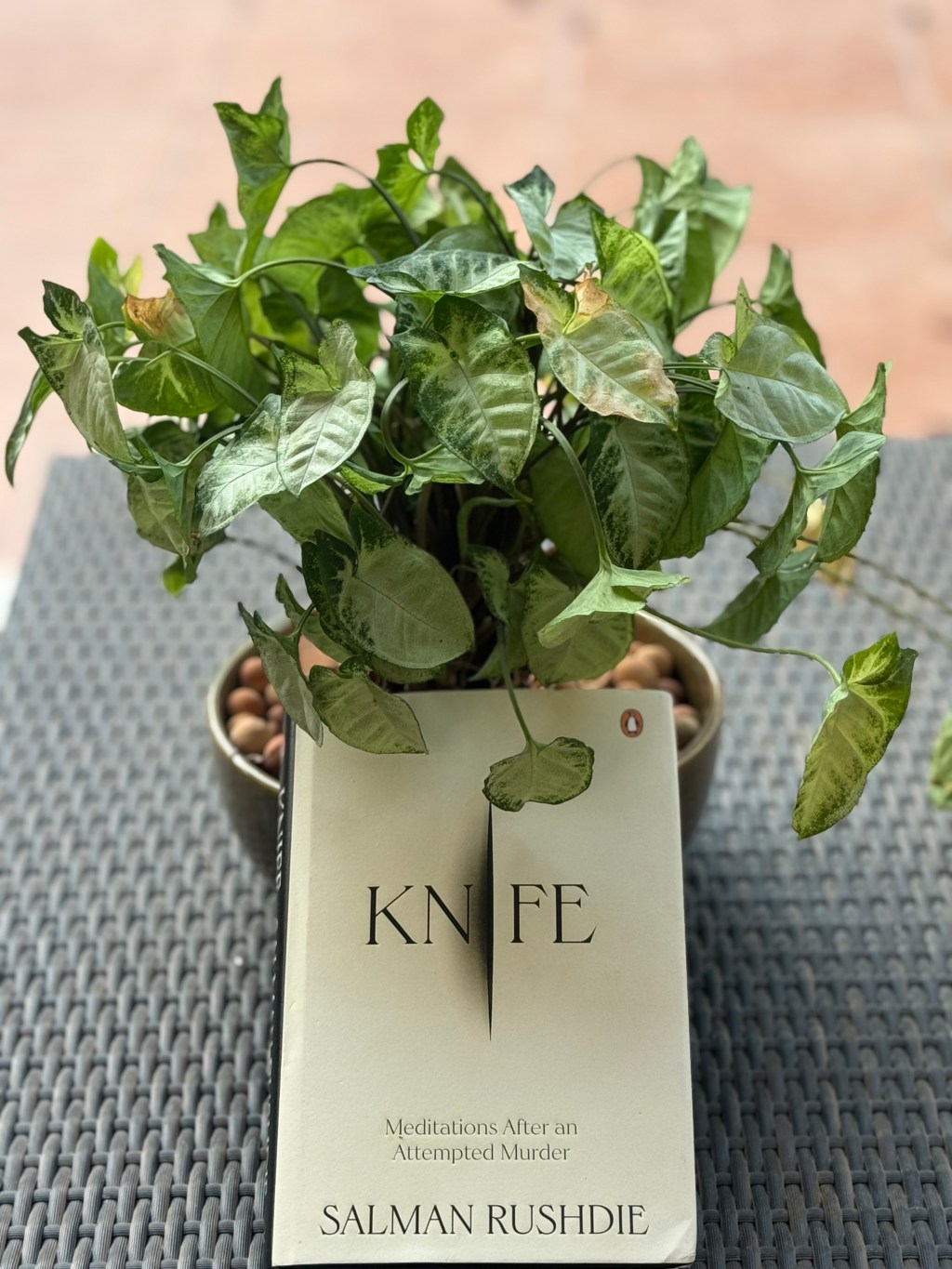
PUB BY: PENGUIN
“One has to find life, I said. One can’t just sit about recovering from near death. One has to find life.”
‘Knife – Meditations after an attempted murder’, is Salman Rushdie’s reflections, introspections, coming-to-terms, and his emotional and physical recovery from the attack, 30 years after the fatwa was issued against him.
“When I decided that I was going to write the book, the very first thing I wrote was ‘knife’……..Then, the more I thought about it, I realised that the book is my knife, my way of fighting back, and taking control of the narrative, It’s my tool. I don’t have knives or guns or weapons, but I have language. And I’ve been using that tool for half a century.” Salman Rushdie in Times of India ( https://timesofindia.indiatimes.com/world/rest-of-world/new-pressure-on-free-speech-coming-from-the-left-and-young-people-salman-rushdie/articleshow/109649523.cms)
The book begins with the attack…. described in telescopic detail, reliving it second by second. There are self-questions as to what he felt, and why he didn’t rescue himself? When he recovers, he sees alphabets… a writer truly!
In the first chapter itself, Salman rues the fact, that the attack brings his book ‘The Satanic Verse’ back into attention. However, he is extremely unapologetic about the book and the criticism he received when the fatwa was issued.
Chapter 2 is personal, talking about his relationship with Eliza and his attainment of happiness. This chapter reveals his personal side and his attachment to his family. It also reveals his conflict of feeling so joyful when the world was in such an unhappy state of COVID-19. “What right did anyone have to claim true happiness in our almost terminally unhappy world?” But helpless in the face of happiness. “And yet the heart knew what it knows, and insisted.” However, the Knife lurks always… “Then cutting that life apart, came the knife.”
Chapter 3 deals with his appreciation of his support system, his family. It narrates his resilience, his determination to fight back. He talks in detail of his physical agony. When the saliva is being packed or when the eyelid is being shut surgically giving one goosebumps making the reader feel the physical pain he goes through. He constantly talks of his sons and sister as being the pillars of his life, of course besides Eliza.
Then, rehab in Chapter 4. Rehab of his injury, of his life. Firstly, when he walks away from a home of abuse and a drunken father. And his struggle to find himself as a writer. The second rehab is after the fatwa…going into hiding. Facing a barrage of unpleasantness from fellow writers and support from unknown quarters. His hurt of the hostility emanating from India, Pakistan, and the South Asian community in the UK still resonates within. “That wound remains unhealed to this day”. The third rehab was his shift to New York to take the bull by the horns…. be public and be seen. And his fourth rehab after the attack ended on September 26, 2021, at Rusk, New York in a loft lent to him by his friends to hide from the lenses and glares.
Salman Rushdie is a master of words. His literary references, his quick flash to the yesterdays, and his crafty use of words is what make him the writer that he is. There are some sentences wherein to emphasise, he uses one word and its synonyms at a go to hit the nail home. His continuous references to other literary works and books display his prolific panoramic attachment to words.
“Language, too, was a knife. It could cut open the world and reveal its meaning, its inner workings, its secrets, its truths……”.
His satirical description of the prostrate cancer tests is witty and demonstrates his determination to embrace life and rise above all.
Chapter 6. Conversations with A (he has named the assailant so). Salman Rushdie’s imaginary conversations with his assailant is a catharsis. Confrontation. Attacking convictions. Assailing the beliefs. An attempt to get into the mind of A. Trying to root out his theory, his belief, and his faith. He is making an effort to analyse what made A wield the knife. Conversations are questions seeking answers and an attempt by the author to deeply understand the mind of the assailant and attack him back with words.
I am sure he must have been itching to write this chapter. To confront. To argue. To fathom. To award guilty. To try for a change?
Chapter 7. Second Chance. “the eye… is an absence with an immensely powerful presence.” This chapter talks of his coming back to public, simple pleasures of being in Central Park. His take on public vs private religious beliefs. His anticipation and an underlying fear of his assassin A being convicted or being left free. Talks of liberty.
Chapter 8. Closure? The question mark says it all. There can never be a full closure. Shadows always hang around, peeping, whispering, reminding. But shadows have to be nudged off, pushed away, to come to peace… to feel ‘lightness’ as the author says on the last page of the book. The book ends with him revisiting the site of the scene…. In Salman Rushdie’s opinion, three things helped him to deal with the horrific trauma. Time. Therapy. Writing this book. He talks of his difficult period of coming to terms with the loss of one eye. But he confesses that Mansoor Ali Khan Pataudi became his inspiration, a man who had a prolific cricketing career with just one eye.
There is no area of self-pity in the book. Facts. Acceptance. Options. Decisive decisions. When one ends the book, one is left mulling. How did I feel after I turned the last page of the book? This book is written by a man who has faced whatnot, but is determined to swim to the surface after plunging into deep depths of fear, horror, and pain.
“I’ve become a strange fish, famous not so much for my books as for the mishaps of my life… It will affect the way my writing is read. Or not read. Or both.”
 Preeta Chag