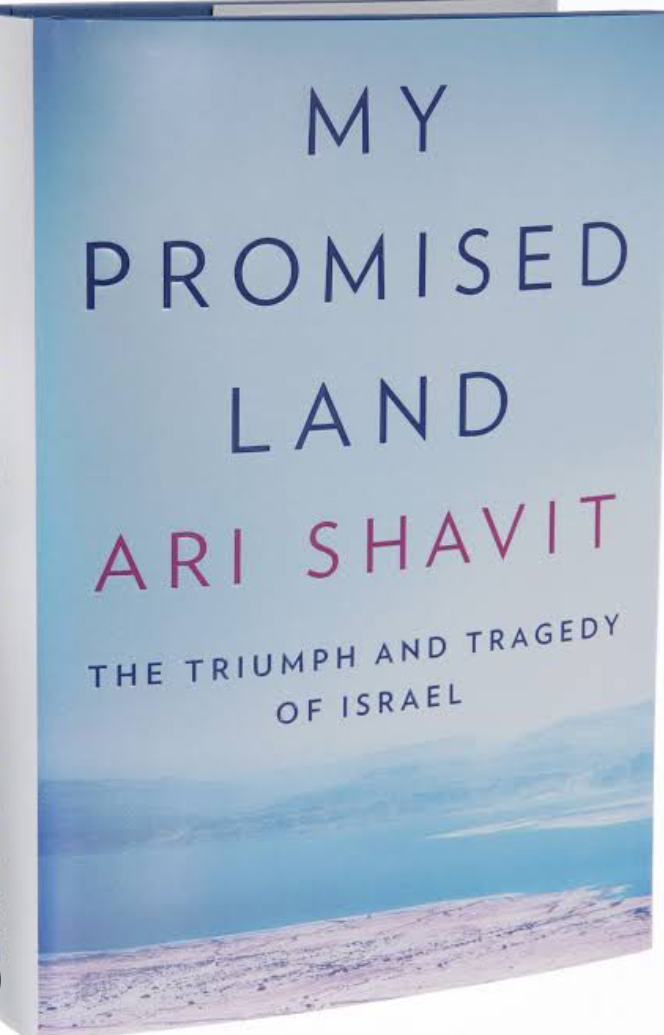
PUBLISHED BY: RANDOM HOUSE
Highly recommended.
“We dwell under the looming shadow of a smoking volcano.”
Written in 2013, the words of this book hold true even today for Israel, a land that is so permanently on-the-edge.
‘A Promised Land: The Triumph and Tragedy of Israel’ by Ari Shavit is a personal introspection of the author into the land’s birth, occupation, existence and survival. As he writes in the beginning, “This book is the personal odyssey of one Israeli who is bewildered by the historic drama engulfing his homeland.”
The author is a proud Israeli, but with no blinkers on. He knows the nation is born from blood and intimidation. He condemns the brutality inflicted on the Palestinians, but he also professes the need of survival. Ari Shavit lays bare the duality of each chapter of the country’s existence.
Terror perpetrated. Terror suffered. Occupation. Intimidation. Tales of brutality. Tales of prevailing. A nation whose origin and living is enshrined in blood and violence.
‘My Promised Land’ begins with a journey of the group of early Zionists who travelled from London to Jaffa led by Rt Honorable Herbert Bentwich, the author’s great grandfather.
The book is divided into 17 chapters, each chapter dealing with the journey of the country and its evolution with tales of horror and dread, along with fortitude and courage.
In Chapter 2, Into the Valley, the author Ari Shavit describes dramatically, the entry into the Valley of Harod. The seeds of Israel are sown. And comes into existence a state whose sustenance will always be defined by the intimidation it is surrounded with and the cruelty it inflicts.
Israel is a nation born from a steely determination. Chapter 4 Masada is spine-chilling in its intensity of courage and commitment. Shmaryahu Gutman was the chief person instrumental in turning Masada from a symbol of defeat, death, and destruction to an ethos of unification of Hebrew youth. A formative set of New Zionism. The first journey in January 1942 was the beginning of a movement. A cacophony of strong resolution and fervent energy.
But Israel is also a land born from spilled blood, coercion, and forced occupation. Chapter 5, Lydda. The dark chapter of expulsion and destruction. “If Zionism was to be, Lydda could not be.” The chapter is a gory reminder of the law of the jungle-the survival of the fittest.
A nation of conflicting stories and identities, Chapter 6, Housing Estate are stories of endurance. The stories of the four fatal survivors are stories of despair, torment, loneliness, and finally, survival.
Professor Sternhell. “From the age of seven, I had no one to talk to. …..I erased everything.”
Aharon Applefield. “From village to village, from forest to forest. I survived like a field animal.”
Aharon Barak. “My mother and I lived in the one and a half meters between the walls for six months.”
Louis Aynachi. “The world had shifted from its natural course. The impossible had happened.”
Ari Shavat has narrated four of the stories of around 7,50,000 Jewish refugees who arrived in Israel between 1945 and 1951. Stark. Brutal. Incisive. Compassionate. This influx of refugees necessitated the national projects of the 1950’s of Housing, Agricultural settlement, and Industrialisation setting in motion the establishment of the state of Israel.
Chapter 11, J’Accuse deals with the integration of Oriental Jews into the mainstream Israel. The whole chapter dwells on the tortured soul of citizens yet finding ways to belong. Way to integrate. Way to be one. Way to be Israeli.
The author has, in the end, defined seven circles of threat to the country: Islamic, Arabic, Palestinian, internal, mental, moral, and identity-based. And his biggest question is: the survival of Israel.
“Our cities seemed to be built on shifting sand. Our houses never seemed quite stable.”
The book is a reflection: questions seeking answers, the right questioning the wrong, and the light wanting to embrace the dark.
“Both occupation and intimidation make the Israeli condition unique. Intimidation and occupation have become the two pillars of our condition.”
Ari Shavat is self-questioning, self-explaining. The book seems a catharsis of his inner conflict, his dilemma, his country’s dilemma, and his adversaries’ dilemma.
“We dwell under the looming shadow of a smoking volcano.”
 Preeta Chag