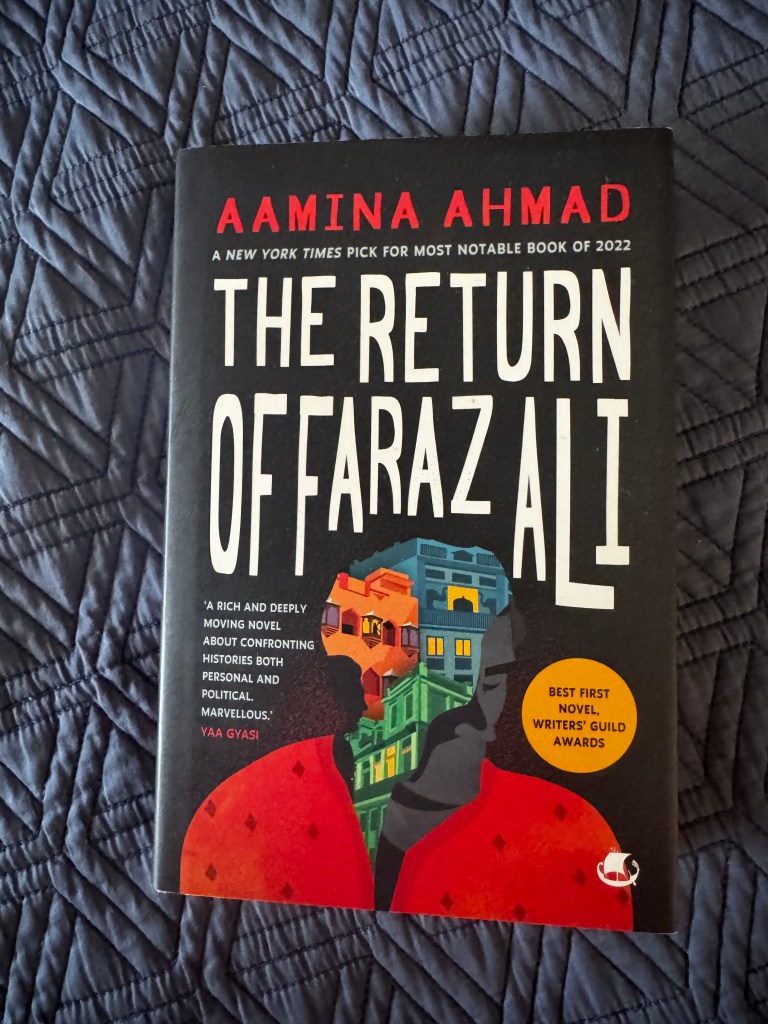
Pub by: Sceptre, an imprint of Hodder and Stoughton (April 2022)
Written on a canvas of troubled history, and painted with guilt, fear, and agony, “The Return of Faraz Ali” by Aamina Ahmad is a book exploring and comprehending human emotions, so complex amidst a troubled existence.
Set in the late 1960s, the book begins with the killing of Sonia, a young girl in the Mohalla of Lahore, the famous red-light district area. Faraz Ali is sent to hush up the case, propelling memories galore and a yearning to come face to face with one’s own history. Faraz Ali’s mother Firdaus was a sex worker in the Mohalla, but Faraz was taken away by the father Wajid who now sends him to do his bidding. But Faraz Ali is unable to do the assigned task, and tries to dig deeper into the killing of Sonia setting off his punishment by sending him to then East Pakistan, which is in a state of uproar then.
An unabashed disregard for human life, by the rich and powerful-each page of the book is an emotional tale narrating the stories of the characters against the volatile background of Pakistan. History has been interwoven deftly with the narration: Faraz Ali’s deputation to East Pakistan and his torment. Wajid’s narrative from World War II and pre-independence to Pakistan in the 1970s; and the political unrest in Pakistan in late 60s.
The book is stormy, but strangely melancholic amidst the high- intensity drama taking place on each page. All the characters are well-etched in their rawness of emotion and the desperation lurking all around.
The book begins as a crime investigation, but wallops and transcends into a tale interlaced with history and culture, but consumed by power and injustice.
The book reads like a yearning. Constantly seeking answers. Constantly seeking salvation. Constantly seeking refuge.
However in the later part of the book, the story continuously flits across different time zones making the concentration a little difficult.
Regardless, the book is an enjoyable read, a great debut for the author who I am sure will be churning out more such historical novels in the future.
 Preeta Chag
Leave a comment