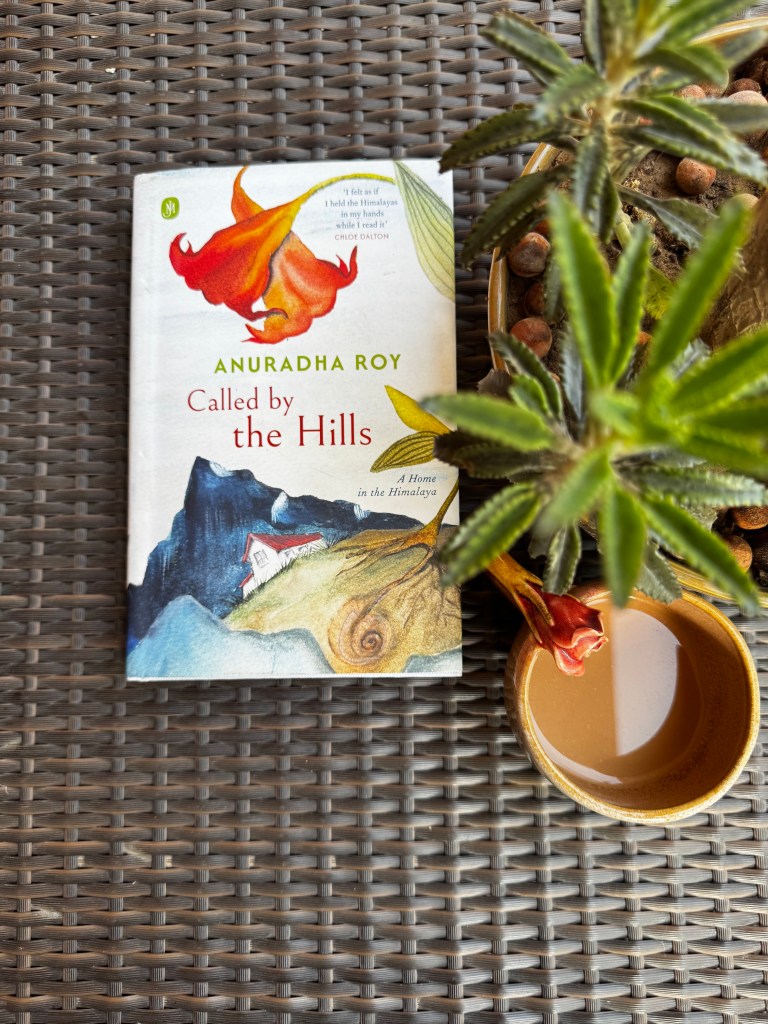
Pub by: Hachette India (2025)
‘Called by the Hills-A Home in the Himalaya’ is a reader’s trip to the mountains.
Of trees, and the voice of the birds. Of the dogs walking alongside, the surrounding wilds and the reader (me) lifting my face up to inhale the fresh mountain air.
“Only a few things in life can be pinned to particular moments. This was one. We knew, R and I, that some day we would live in the cottage on that hill.”(page 3)
When Anuradha Roy stumbles upon this cottage, their lives change forever. From the glittering lights of Delhi, she, along with her husband Rukun, make this momentous decision to shift to the hills in Ranikhet. And create their own small haven in the mountains.
This book is her journey.
Of settling, understanding, blending. Of creating her life with her plants, dogs, her garden, her community and the wilderness all around.
The book is about the wild.
“We lived in endless forest.” (page 37)
Her diving into the unknown. Trying to tame some, and let some be uncultivated. She draws the reader into the mountains, weaving and unmasking images with her prose, the raw beauty of her environs.
Yet the book is about stillness.
The narration is poetic, beckoning the reader into a world of trees, lights, shadows, thrushes, leopards… the dangers are narrated, but there is a calm acceptance of the jungle around… an unspoken merging in.
It was not easy, I am sure. The author has glossed over major difficulties, emphasising her urge to be there. Of course, she writes about the earlier days, when there was no internet and running with the laptop from here to there, trying to catch a bar to connect.
“One long tense night a leopard circled our house, coughing without pause after it missed a kill.” (page 17)
She talks of interesting experiments.
Inspired by one passage in “Four Hedges” by Clare Leighton, she played Mozart’s Oboe Quartet on the phone. “It was the strangest thing: a whole flock of laughing thrushes……descended on the feeder in minutes.” (page 135)
She talks of many authors.
Anuradha Roy has quoted many authors who have written extensively on the mountains. Leela Majumdar. Frank Smythe. Clare Leighton. Peter Matthiessen. And others. I wish the book had a bibliography of the extensive authors she has quoted.
The book narrates the interactive lives of humans, nature and animals… the coexistence comes alive and vibrant all through.
Each page evokes images – of the messy garden, of the mountains, of the adjoining quarters, of the untamed surroundings. Her attempts to grow a structured garden (lemon trees and all), to merge with the local community, and ultimately to watch man-made development creep, claw and disturb the natural habitat.
The last chapter, ‘The Wounded Mountain’, talks of the badly damaged, fragile ecosystem. So loosely is the term ‘climate change’ used to blame the ravaged mountains. Does man have no responsibility for the extensive damage and exploitation of the once wild and roaming free trees, rivers, animals, and streams?
She talks poignantly of Jerry- her companion dog taken away by the leopard out for a hunt due to encroaching civilisation into its terrain. Her book’s dedication to Jerry is her tribute to his memory.
The book is also a physical beauty. The lovely binding, the smooth white pages adorned with a lovely pink rim, and the beautiful, evocative artworks by the author herself. The book is, by itself, a sensory delight.
“I still feel fraudulent when I fill in ‘writer’ in the box next to Occupation. Is mine a real occupation?…..to write something nobody is asking you to write nor waiting for-is that work? Lives wouldn’t be lost without one more book.” (page 142)
Lives wouldn’t be lost for sure. But we would miss this wild and peace she has managed to create in the pages that she has written.
The book calls to be read.


Leave a Reply